
Bicon Dental Implants for Difficult Bone Cases
Bicon implants are not “magic implants,” and they are not right for every patient. Their value is that their short, plateau-style design and locking-taper connection may give Dr. Nguyen more treatment options in selected difficult cases — especially when bone height is limited near the sinus, nerve, or thin jawbone.
Why “Not Enough Bone” Is a Common Implant Problem
After a tooth is removed, the jawbone in that area can shrink over time. Gum disease, infection, trauma, long-term denture wear, sinus anatomy, and natural bone shape can also leave patients with less bone than ideal. A standard long implant may not fit safely if the bone is too short, too narrow, or too close to important anatomy.
That does not always mean the patient cannot have an implant. It means the case needs careful diagnosis and planning.
What Makes Bicon Implants Different?
The Bicon system is known for several design features: short implant options, a plateau root-form design, a sloping shoulder, and a locking-taper implant-to-abutment connection. Bicon states that its plateau design allows for the use of short implants, and its locking-taper connection provides restorative flexibility.
Short implant options
May help selected patients with limited bone height where longer implants are not practical.
Plateau root-form design
Instead of a traditional threaded shape, the implant uses plateaus designed to support bone integration.
Locking-taper connection
The abutment connection is designed to lock without a traditional screw in many Bicon restorations.
Restorative flexibility
360-degree abutment positioning can help with crown positioning when implant angle is challenging.
Sloping shoulder
May help support gum and crown emergence when planned properly.
Still case-dependent
Short implants must still be placed with enough bone, good bite control, and careful restoration design.
How Bicon Can Help in Difficult Bone Cases
Short implants are useful because they may fit in areas where standard-length implants are limited by anatomy. For example, the upper back jaw may have limited bone because of the sinus. The lower back jaw may have limited bone because of the nerve. A short implant may sometimes reduce the need for larger procedures.
| Difficult case | Why standard implants may be hard | How Bicon may help in selected patients |
|---|---|---|
| Upper back jaw near sinus | Sinus may limit available vertical bone height. | A short implant may fit below the sinus in selected cases, possibly reducing need for sinus lift. |
| Lower back jaw near nerve | The inferior alveolar nerve limits safe implant length. | A short implant may help stay above the nerve if bone width and quality are adequate. |
| Bone shrinkage after extraction | The ridge may lose height and width over time. | Short implant options may expand possibilities, but width and prosthetic space still matter. |
| Older patient avoiding major surgery | Large grafting procedures may take time, cost more, and require more healing. | In selected cases, short implants may simplify the surgical plan. |
| Complicated crown angle | Implant position may not line up perfectly with the ideal crown position. | Bicon’s restorative flexibility can help crown design when planned carefully. |
Why Cone Beam CT Is Critical Before Implant Surgery
A regular dental X-ray is useful, but it is flat. Implant planning often needs a 3D view. Cone beam CT shows bone height, width, shape, density, sinus location, nerve location, neighboring roots, infection, and available space for the implant and crown.
CBCT is especially important in difficult bone cases because millimeters matter. The goal is not just placing an implant; the goal is placing the right implant in the right bone, at the right angle, with enough room for a cleanable crown.
Measures bone in 3D
CBCT helps evaluate height, width, and shape of the ridge.
Protects anatomy
Helps identify nerves, sinus, and nearby roots before surgery.
Plans implant position
Helps choose implant size, angle, and location.
Plans the crown too
The implant should be placed for the final crown, not just where bone is easiest.
SoftDental Workflow: Exam, CBCT, Microscope, Surgery, Crown
At SoftDental, Dr. Nguyen’s implant workflow is designed to reduce guessing. The process starts with diagnosis and ends with a crown that is designed around the patient’s bite, gum tissue, and ability to clean.
Comprehensive implant exam
Dr. Nguyen evaluates the missing tooth area, gum health, bite, medical history, smoking status, diabetes control, and patient goals.
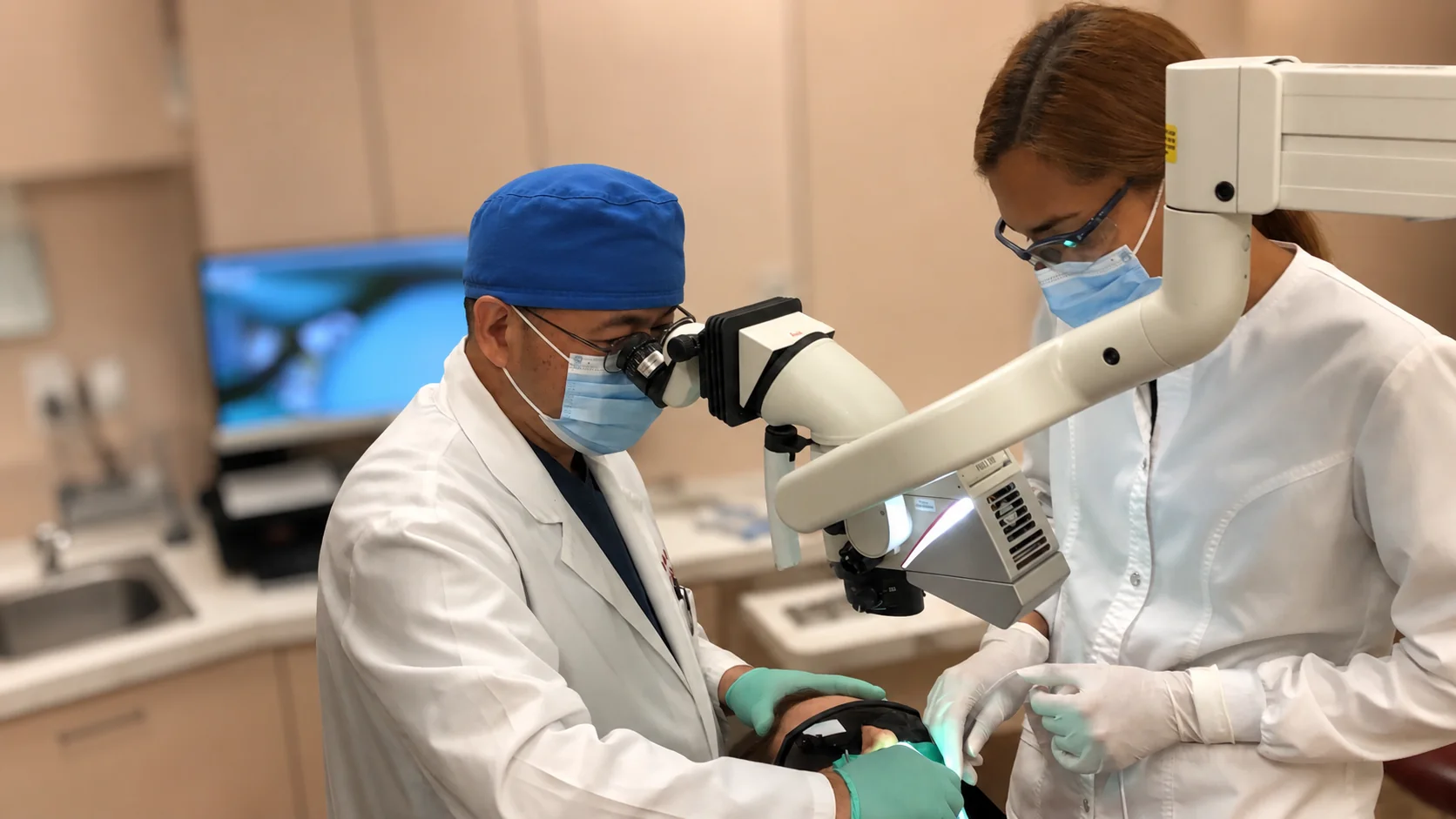
Microscope-assisted evaluation
Magnification and strong lighting help Dr. Nguyen inspect the tissue, teeth, cracks, margins, infection, and surgical/restorative details more carefully.
Cone beam CT scan
CBCT allows 3D evaluation of bone, sinus, nerve, roots, and implant space before surgery.
Implant planning
Dr. Nguyen decides whether Bicon short implant, bone grafting, sinus lift, another implant system, or another tooth replacement option is best.
Microscope-assisted surgery
During surgery, magnification helps Dr. Nguyen work precisely with tissue, bone, and implant placement details.
Healing phase
The implant must integrate with bone. Healing time varies based on bone quality, grafting, infection, and patient health.
Phase 2 and crown design
For phase 2 implant restoration, Dr. Nguyen designs the implant crown for the patient instead of simply leaving the crown design to a lab technician. The design considers bite, gum shape, hygiene access, aesthetics, and implant position.
Why Dentist-Designed Implant Crowns Matter
An implant crown is not just a white tooth on top of an implant. The crown shape affects chewing, food trapping, gum health, cleaning access, speech, and how forces travel into the implant. If the crown is too bulky, too flat, too tight, or poorly shaped, the patient may have food impaction, gum irritation, bite overload, or difficulty cleaning.
For phase 2 implant treatment at SoftDental, Dr. Nguyen designs the implant crown with the patient’s clinical details in mind. The lab may help fabricate the restoration, but the dentist-led design protects the medical and functional goals of the case.
Visual Guide: Short Implant Planning in Limited Bone
This diagram is simplified. Real implant planning requires CBCT measurement, bite analysis, bone quality assessment, and restorative planning.
Benefits of Bicon Implants for the Right Patient
May work with less vertical bone
Short implants may help selected patients where bone height is limited.
May reduce grafting complexity
Some cases may avoid larger grafting procedures, though grafting is still needed for some patients.
Screwless locking-taper concept
The connection design may reduce certain screw-related restorative complications in appropriate cases.
Restorative flexibility
Abutment positioning can help when crown position and implant angle are challenging.
Gum and aesthetic planning
The sloping shoulder and crown design can support natural-looking tissue contours when planned well.
Useful in advanced planning
Works best when the surgical and crown phases are planned together, not separately.
Risks and Limitations Patients Should Understand
No implant system is risk-free. Bicon implants can be excellent in the right case, but they are not the right answer for every mouth. Patients should understand the limits before choosing treatment.
| Risk / limitation | Why it matters |
|---|---|
| Not enough bone width | A short implant still needs enough width and healthy bone around it. |
| Heavy bite or grinding | Short implants and implant crowns must be protected from overload. |
| Active infection or gum disease | Infection must be controlled before or during implant treatment. |
| Smoking, uncontrolled diabetes, poor healing | Medical and lifestyle factors can reduce implant success. |
| Poor hygiene access | The implant crown must be cleanable; otherwise peri-implant inflammation may develop. |
| Large bone defects | Some cases still require grafting, sinus lift, ridge augmentation, or alternative treatment. |
| Unrealistic expectations | An implant replaces a missing tooth; it is not immune to gum disease, bone loss, bite overload, or maintenance problems. |
Who May Be a Good Candidate?
| May be a good candidate | May need additional treatment first |
|---|---|
| Missing one or more teeth with limited vertical bone but adequate width. | Active infection, abscess, or untreated periodontal disease. |
| Patient wants to avoid larger grafting if clinically safe. | Bone is too thin or too soft to support even a short implant safely. |
| CBCT shows safe distance from sinus, nerve, and neighboring roots. | Sinus or nerve position makes implant placement unsafe without additional treatment. |
| Bite forces can be controlled with proper crown design. | Severe grinding, unstable bite, or untreated bite collapse. |
| Patient can maintain oral hygiene and follow recall visits. | Poor home care or inability to clean around the implant crown. |
Questions to Ask Before Choosing a Bicon Implant
How much bone do I have?
Ask Dr. Nguyen what the CBCT shows for height, width, density, sinus, and nerve position.
Do I need bone grafting?
Ask whether a short implant can safely reduce grafting or whether grafting is still recommended.
How will my bite affect this implant?
Grinding, clenching, and bite imbalance can affect implant loading.
How will the final crown be designed?
The crown must fit the bite, look natural, and be easy to clean.
What maintenance will I need?
Implants require brushing, flossing or special cleaning tools, and periodic dental checks.
A difficult bone case should not be guessed. Bicon short implants may give us more options, but the decision must come from diagnosis: cone beam CT, microscope-level attention to detail, bite analysis, and a crown design that the patient can clean and use long term.
— Dr. Minh Nguyen, D.D.S., P.A. · SoftDental HoustonSources and Further Reading
Bicon Dental Implants: Bicon SHORT® Implants — describes Bicon's plateau design, short implant options, locking-taper implant-to-abutment connection, and 360-degree universal abutment positioning.
Bicon Dental Implants: Literature and Publications — notes that Bicon's implant design has been in use since 1985 and provides publications on the Bicon system.
JADA: The role of cone-beam computed tomography in implant planning — explains that 3D imaging, especially CBCT, has contributed significantly to implant planning and placement.
Were you told you do not have enough bone for an implant?
Get a 3D implant evaluation before giving up.
Dr. Nguyen can evaluate your bone with cone beam CT and discuss whether Bicon short implant, grafting, sinus lift, bridge, partial denture, or another option is safest for your case.
Bicon Implants · Cone Beam CT Planning · Microscope-Assisted Implant Surgery · Implant Crown Design · Difficult Bone Cases
This article is for patient education only and is not a diagnosis, guarantee, or promise that Bicon implants will work for every patient. Implant candidacy depends on bone height, width, density, sinus and nerve anatomy, infection control, gum health, bite force, smoking, diabetes control, medication history, hygiene, and maintenance. © 2026 SoftDental | Dr. Minh Nguyen DDS PA · 10028 West Road Ste. 108, Houston TX 77064 · 281-807-6111
Questions about your own teeth?
Our team is happy to answer them in person, without pressure. Call us or book a visit.
Educational information only. Not a substitute for a personal exam with a licensed dentist.