
Why Do I Need a Root Canal — and Why Do I Need a Crown After?
One of the most common mistakes patients make after a root canal is stopping halfway. The pain is gone, so they think the problem is gone. But pain relief only means the infected nerve tissue has been treated. The tooth itself may still be weak, cracked, heavily filled, or missing too much structure to survive normal chewing without a permanent restoration.
The Misconception: “My Pain Is Gone, So I Am Finished.”
“If the root canal stopped the pain, I do not need the crown.”
The root canal treats the infection. The crown protects the weakened tooth.
A root canal removes inflamed or infected pulp from inside the tooth, disinfects the canal system, and seals it. That helps save the tooth. But many root canal teeth already have deep decay, a crack, a large old filling, or missing tooth structure. Without a crown or proper final restoration, the tooth can leak, crack, or break later.
What Is a Root Canal Treatment?
Inside every natural tooth is a small space that contains pulp tissue: nerves, blood vessels, and connective tissue. When that tissue becomes inflamed, infected, or dead, the tooth may need root canal treatment. Common causes include deep cavities, repeated dental work, a crack or chip, trauma, large old fillings, or infection around the root.
Root canal treatment is designed to remove bacteria from the infected canal system, prevent reinfection, and save the natural tooth when the tooth is restorable.
Infection inside the tooth
Deep decay or cracks allow bacteria to reach the pulp. The pressure and inflammation can cause severe pain, swelling, or a dental abscess.
Hot, cold, or biting pain
Lingering sensitivity, throbbing pain, pain when chewing, or waking up from tooth pain may mean the pulp is damaged.
Goal: save the tooth
The purpose is not to “kill the tooth.” The purpose is to remove diseased tissue, disinfect the roots, and keep your natural tooth functioning.
Final crown protection
After the inside is treated, the outside must be sealed and protected so chewing forces do not split the tooth.
What Happens During a Root Canal?
Diagnosis and imaging
Dr. Nguyen evaluates symptoms, X-rays, bite pressure, swelling, gum findings, and whether the tooth can be restored. When needed, cone beam CT provides a 3D view of the tooth roots, bone, infection area, and anatomy that may not be fully visible on a regular 2D X-ray.
Exam · X-ray · CBCT when indicatedLocal anesthesia and tooth isolation
The tooth is numbed. The area is isolated so the tooth stays clean and dry during treatment.
Comfort and infection controlAccess and microscope visibility
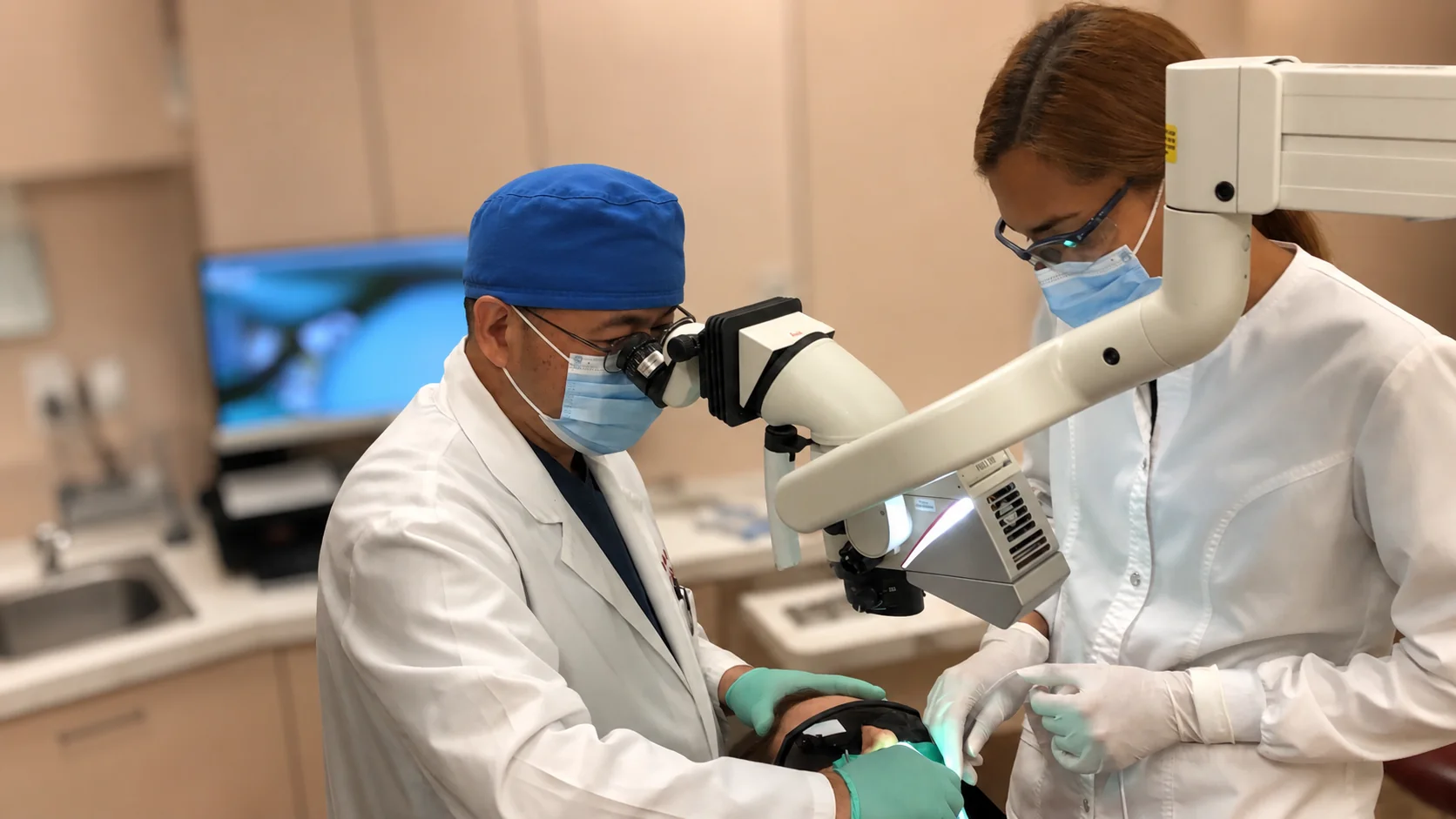
A small opening is made through the top of the tooth to reach the canal system. At SoftDental, Dr. Nguyen uses a Leica microscope to improve visibility while working inside narrow root spaces.
Leica microscope precisionCleaning, shaping, and disinfection
The inflamed or infected pulp tissue is removed. The canals are cleaned, shaped, disinfected, and prepared for sealing.
Remove infection inside the rootsFilling and sealing the canals
The cleaned canals are filled with a root canal filling material, then the tooth is sealed with a temporary or buildup material until the final crown is completed.
Seal the inside of the toothCrown or final restoration
For many back teeth and weakened teeth, a crown is needed after root canal treatment. The crown covers and protects the remaining tooth so the tooth can handle chewing force more safely.
Do not stop after pain reliefWhy the Crown Matters After Root Canal Treatment
A tooth that needs a root canal usually did not start as a perfectly healthy tooth. It often had a large cavity, big filling, crack, fracture, or infection before treatment began. Root canal treatment cleans the inside, but it cannot rebuild missing walls of tooth structure by itself.
A root canal treats the infected inside of the tooth. The crown protects the outside from chewing forces, leakage, and fracture.
| Patient thought | What is true clinically | Why it matters |
|---|---|---|
| “The pain is gone.” | The nerve infection has been treated. | The tooth may still be structurally weak. |
| “The temporary filling is enough.” | Temporary fillings are not designed to protect the tooth long-term. | Delay can lead to leakage, reinfection, or fracture. |
| “I can chew normally right away.” | The tooth may be brittle, cracked, or missing walls. | Hard chewing before the crown can split the tooth. |
| “I will come back if it hurts.” | A root canal tooth may not warn you with normal nerve pain. | The first sign of trouble may be a broken tooth. |
What Can Happen If You Skip the Crown?
Tooth fracture
Back teeth take heavy chewing forces. If the remaining walls are thin, the tooth can crack vertically or break below the gumline.
Leaking temporary filling
A temporary or weak filling can leak over time. Bacteria can re-enter and cause reinfection.
Extraction risk
If the tooth breaks too deeply, the root canal investment may be lost and the tooth may need extraction.
Higher replacement cost
Losing the tooth can lead to implant, bridge, partial denture, bone graft, or space-maintenance problems.
How SoftDental Uses CBCT and a Leica Microscope
Root canals are performed in very small spaces. Some teeth have narrow canals, curved roots, extra canals, calcified canals, or infection patterns that are difficult to see on a regular X-ray. Better visualization can help the dentist diagnose and treat the tooth more precisely.
Cone beam CT / CBCT
CBCT creates a 3D view of teeth and surrounding bone. It can help evaluate root shape, infection around the root, sinus proximity, prior root canal problems, missed canals, and cracks when clinically indicated.
Leica microscope
A dental microscope improves light, magnification, and visibility while working in narrow root canal spaces and during crown preparation.
Diagnosis before treatment
Technology helps Dr. Nguyen determine whether the tooth is restorable, whether root canal treatment is appropriate, and whether a crown is needed after treatment.
Does Every Root Canal Tooth Need a Crown?
No. The answer depends on the tooth. Front teeth sometimes have enough remaining structure to be restored with a bonded filling. Back teeth usually handle heavier chewing pressure, so they often need a crown or onlay after root canal treatment.
| Tooth situation | Likely restoration | Reason |
|---|---|---|
| Back molar or premolar after root canal | Crown or onlay is commonly recommended | These teeth take strong chewing forces and are more likely to fracture without cuspal coverage. |
| Large old filling or missing tooth walls | Crown is usually needed | The tooth has lost too much support to rely on a filling alone. |
| Cracked tooth | Crown may be urgent after root canal | The crown helps brace the tooth and reduce crack progression risk. |
| Front tooth with small access and strong structure | Filling may be enough in selected cases | Front teeth usually do not take the same vertical chewing load as molars. |
What Should Patients Do After a Root Canal?
Do not chew hard foods on the treated tooth until it is fully restored.
Use the other side if possible. Avoid ice, hard nuts, hard candy, sticky foods, and biting directly on the temporary.
Schedule the crown promptly.
Do not wait until the tooth hurts again. A root canal tooth may not give normal pain warnings before breaking.
Call if swelling, bite pain, or temporary loss occurs.
Some soreness is normal for a few days, but increasing pain, swelling, bad taste, or a lost temporary filling should be checked.
Keep cleaning around the crown.
A crown protects the tooth structure, but it does not prevent gum disease or new decay at the edge of the crown.
The goal of a root canal is not just to stop pain for today. The goal is to save a natural tooth for years. That means treating the infection inside the tooth and protecting the outside with the right final restoration.
— Dr. Minh Nguyen, D.D.S., P.A. · SoftDental, Houston TXRoot Canal and Crown FAQ
Is a root canal painful?
Most root canal treatment is done with local anesthesia. Patients may feel pressure or vibration, but the goal is to keep the tooth comfortable during treatment. The tooth and surrounding area may feel sore for a few days afterward.
Why did my tooth stop hurting before treatment?
Sometimes the nerve inside the tooth dies. Pain may decrease temporarily even though infection remains around the root. A quiet tooth can still have an active infection.
Can antibiotics replace a root canal?
Usually no. Antibiotics may help control spreading infection, but they do not clean infected pulp tissue from inside the root canal system. The source of infection still needs dental treatment.
How long can I wait to get the crown?
Do not delay. Timing depends on the case, but the crown or final restoration should be completed as soon as Dr. Nguyen recommends. Waiting increases the risk of fracture and leakage.
Can I just extract the tooth instead?
Extraction is sometimes necessary if the tooth cannot be restored. But if the tooth can be saved, root canal plus crown may help preserve your natural bite, chewing function, and bone support.
Research and clinical sources used
- American Association of Endodontists. Root Canal Treatment. aae.org
- American Association of Endodontists. What Is a Root Canal? aae.org
- American Dental Association MouthHealthy. Root Canals. mouthhealthy.org
- American Dental Association MouthHealthy. Crowns. mouthhealthy.org
- American Association of Endodontists. Cone Beam Computed Tomography. aae.org
- American Association of Endodontists and AAOMR. 2025 update on CBCT use in endodontics. aae.org
- Suksaphar W, et al. Survival rates against fracture of endodontically treated posterior teeth restored with full-coverage crowns or resin composite restorations: a systematic review. PMC
- Leica Microsystems. Dental Surgical Microscopy. leica-microsystems.com
Do not stop at pain relief.
If you were told you need a root canal or crown, let Dr. Nguyen evaluate the tooth before the problem becomes an extraction. The goal is to save the natural tooth when it can be saved safely.
Leave a Review →
Cone Beam CT · Leica Microscope · Crown and Restorative Care
This article is for patient education only and is not a diagnosis or guarantee of treatment outcome. Root canal and crown recommendations depend on clinical exam, X-rays, CBCT findings when indicated, tooth restorability, bite forces, gum health, and patient-specific risk factors. © 2026 SoftDental | Dr. Minh Nguyen DDS PA · 10028 West Road Ste. 108, Houston TX 77064 · 281-807-6111
Questions about your own teeth?
Our team is happy to answer them in person, without pressure. Call us or book a visit.
Educational information only. Not a substitute for a personal exam with a licensed dentist.