Your implant crown was rock-solid for years. Then one morning it feels slightly wobbly. Or you hear a faint clicking when you chew. Or you notice it feels different — not painful, just wrong. Before you panic: in the vast majority of cases, this is a loose screw — not a failed implant. And it is one of the most treatable problems in dental implant care.
First, The Parts of Your Implant
Most patients think of their dental implant as a single unit — like a tooth. In reality, a standard implant restoration is three separate components, each held together by a tiny precision screw. When you understand the anatomy, the reason screws loosen becomes far less mysterious.
The abutment screw is approximately 1.5–2mm in diameter and several millimeters long. Its job is to clamp the abutment to the implant fixture with precise torque — typically 25–35 Newton-centimeters. Over thousands of chewing cycles, this screw can gradually back out.
Why Do Screws Loosen?
Implant screw loosening is one of the most common mechanical complications of dental implants, documented across hundreds of clinical studies. The abutment screw loosening rate in posterior single crowns has a documented incidence of approximately 12.7% — meaning it happens to a significant portion of implant patients at some point. Contributing factors include micro-leakage, settling effects, loss of preload, abutment angulation, and inadequate torque application. Here is each cause explained clearly.
⚙️ The "Settling Effect" — Natural Microscopic Movement
When a screw is tightened, the connection between the abutment and the implant fixture is never perfectly smooth at a microscopic level. The tiny surface asperities (microscopic bumps) on both metal surfaces begin to flatten and compress under the repeated load of chewing — a phenomenon called the "settling effect." As these surfaces wear, the screw loses its preload (clamping tension) and begins to back out.
This is a physics problem, not a clinical error. It happens in all precision mechanical connections subjected to cyclic loading — from aerospace bolts to surgical implants. The dental implant screw is not immune.
🦷 Grinding and Clenching (Bruxism)
The forces generated by normal chewing are significant — but the forces from nocturnal grinding can be 5 to 10 times greater. Studies show that bruxism increases implant failure risk by approximately 30%, and screw loosening is one of the first mechanical signs that occurs in grinding patients. The screw is being subjected to forces far beyond what it was designed to sustain nightly.
📐 Off-Axis Bite Forces — How the Crown Meets Opposing Teeth
A screw is designed to tolerate forces in line with its axis (straight up and down). When a crown contacts opposing teeth at an angle — a common scenario with implants because the implant cannot tilt or shift position the way natural teeth can — lateral forces are transmitted to the screw. These bending and shear forces are far more destabilizing than axial loading, and over time they cause screw loosening and can even fracture the screw.
Inadequate implant position, inappropriate occlusal or anatomic design of the crown, and excessive occlusal load are among the documented reasons for loosening. This is why careful bite adjustment at crown delivery is critical — and why bite checks at follow-up appointments matter.
🔩 Under-Torqued Screw at Placement
Each abutment screw has a specific torque specification — typically 25–35 Newton-centimeters depending on the implant system. If this torque value is not reached at placement, the preload is insufficient from day one. The screw will loosen much faster than it should. Insufficient torque force for tightening is one of the documented reasons for implant screw loosening.
📏 Increased Crown Height — Longer Lever Arm
When the space between the gum line and the opposing teeth is greater than normal — either because of significant bone loss or because the implant was placed deeply — the crown is taller than average. A taller crown creates a longer lever arm, meaning the same biting force generates a higher bending moment at the screw connection. Taller crowns have a significantly higher screw loosening rate.
🔄 Worn or Damaged Screw — After Years of Loading
Abutment screws are precision-machined titanium or titanium alloy components. Over many years and thousands of chewing cycles, the screw threads can experience micro-fatigue and wear — especially if the screw has been loosened and re-tightened multiple times. A worn screw may no longer achieve the same preload as a new one even when tightened to the same torque value. Two approaches exist to address this issue: replacing the screw or re-tightening the existing one — and when a screw shows wear, replacement is the better option.
🔗 Implant-Abutment Connection Design
Not all implant connections are created equal. External hexagon connections (older design) are more susceptible to screw loosening than internal conical connections (modern design), because internal connections distribute force more evenly and create a tighter friction seal at the interface. The implant system Dr. Nguyen uses matters for this reason.
At SoftDental, Dr. Nguyen uses both Bicon (platform connection) and Implant Direct (internal connection) implant systems — both of which offer superior stability at the implant-abutment interface compared to older external hexagon designs.
🦠 Bone Loss Around the Implant (Peri-Implantitis)
When bone is lost around an implant due to peri-implantitis or other factors, the implant post becomes less stabilized in the jaw. This allows more micro-movement of the entire implant fixture — which translates into greater stress on the abutment screw. This is the one scenario where screw loosening is a symptom of a more serious underlying problem. Screw loosening presents significant challenges, potentially leading to implant failure, bone loss, and peri-implantitis in a cycle that must be addressed promptly.
When Does Screw Loosening Happen?
Screw loosening can occur at any point in an implant's life — but certain windows carry higher risk. One study showed that 26% of abutment screws need to be tightened again after the first year. The loosening rate of abutment screws is 3.1–10.8% after 5 years. Understanding when it is most likely helps you know what to watch for.
Signs Your Screw May Be Loosening
Crown Wobbles or Rocks
Any movement — even slight — when you press the crown with your tongue or finger is not normal. A healthy implant crown should feel exactly like a real tooth.
Call us within 1–2 daysClicking When You Chew
A new clicking or tapping sound during chewing — especially when biting down — suggests the crown is moving against the abutment. This sound often appears before you notice wobbling.
Schedule an appointmentBite Feels Different
If the implant crown suddenly feels higher or lower than it did before — or if it hits before your other teeth do — the crown or abutment has shifted position.
Schedule soonFood Trapping Around the Crown
A gap between the crown and the gum allows food to pack around the implant. This is both a sign of loosening and a risk factor — trapped bacteria accelerate gum inflammation.
Schedule an appointmentUnusual Taste or Odor
A loose crown allows saliva and bacteria to enter the implant shaft. This can produce a persistent bad taste or odor that does not go away with brushing.
Schedule within a weekSomething Tiny Falls Out
If you find a tiny metallic piece — in food, on your pillow, or in your mouth — that could be the abutment screw itself. Put it in a container and call us immediately.
Call us todayThe Microscope Changes
Everything About Screw Repair
The implant shaft is typically 1.5–2mm in diameter and several millimeters deep. Working inside it without magnification is working blind. The use of a dental operating microscope for retrieval of fractured or loosened implant abutment screws is well-documented in the clinical literature — and it transforms what would otherwise be a high-risk procedure into one that can be performed with precision and confidence.
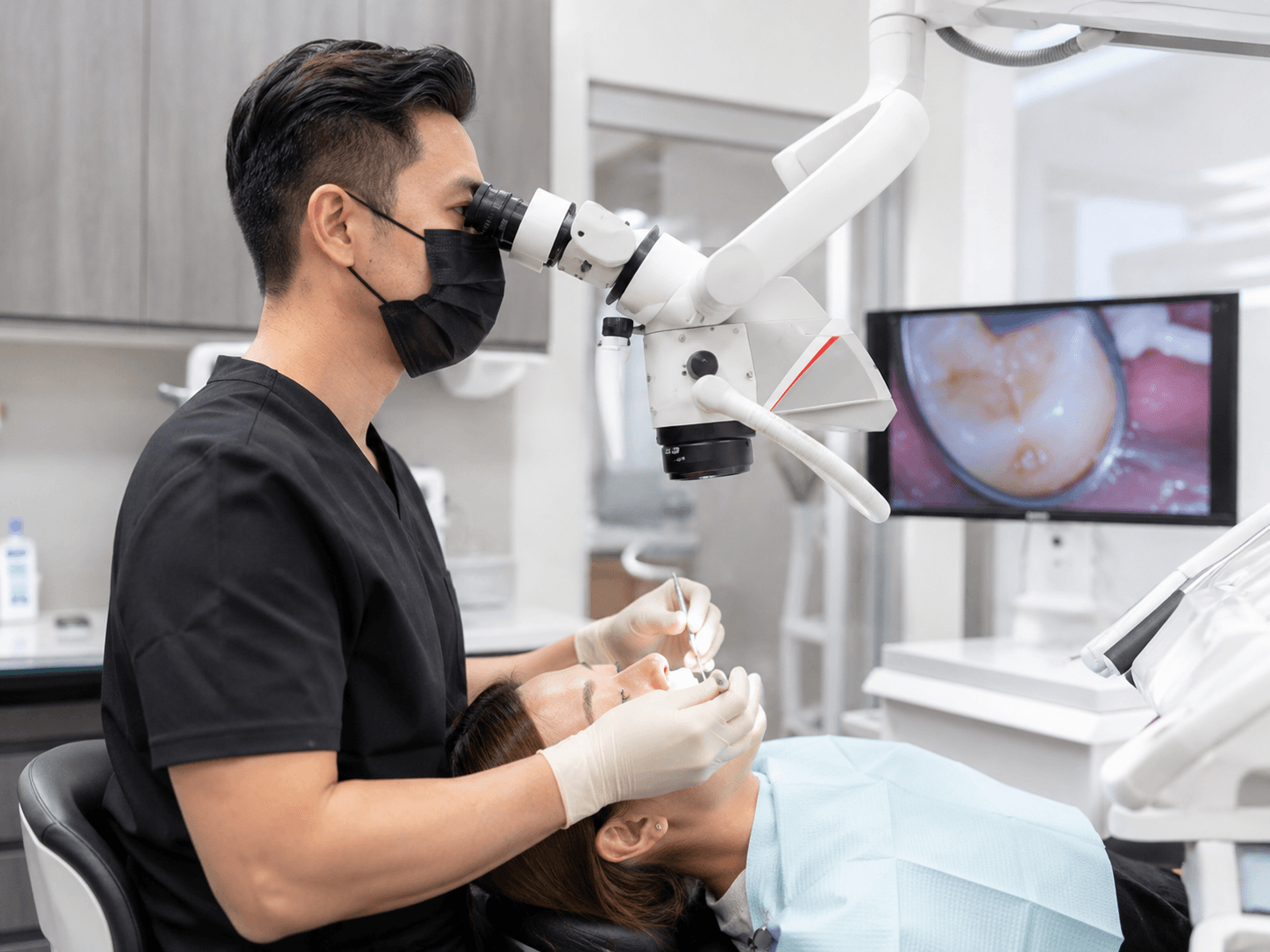
Under the Leica M320 microscope at SoftDental, Dr. Nguyen can see directly into the implant shaft at 10 to 25 times magnification, with coaxial LED illumination eliminating every shadow. What was invisible to the naked eye — the screw head, the hex socket, the thread condition, any debris — becomes a clear, illuminated field.
🔬 Sees directly into the implant shaft
The Leica M320 provides coaxial illumination straight down the implant channel — making the screw head and hex socket clearly visible at 10–25× magnification.
🛡️ Protects implant internal threads
Working without magnification risks slipping instruments that damage the implant's internal threads — turning a $200 screw replacement into a $3,000 implant replacement. The microscope eliminates that risk.
⚡ Retrieves fractured screws
When a screw has broken off inside the implant — the most challenging scenario — the microscope allows Dr. Nguyen to use an ultrasonic instrument and micro-tools to work the fragment out safely. The removal of fractured screw fragments using a dental operating microscope is described in published technical reports.
🔍 Inspects condition before replacement
Under microscopic view, Dr. Nguyen assesses the internal threads of the implant for damage, the condition of the abutment seating surface, and whether any debris contamination needs to be cleaned before the new screw is placed.
📊 Confirms correct torque at replacement
The replacement screw is tightened to the precise torque specification using a calibrated torque wrench — confirmed under magnification to ensure the hex driver is fully seated before applying force.
📝 Verifies complete sealing
After replacement, the access hole is sealed and the margin between crown and gum is inspected under magnification — confirming no gaps where bacteria could enter before the procedure is complete.
What Happens Step by Step
Clinical Examination and X-Ray
Dr. Nguyen confirms the screw is loose, evaluates the condition of the implant and surrounding bone, and takes a periapical X-ray to verify the implant is fully integrated. This step determines whether the issue is purely mechanical or whether bone loss is involved.
10 minutesCrown Access Under the Leica Microscope
For screw-retained crowns, Dr. Nguyen accesses the screw through the occlusal access hole in the crown. For cement-retained crowns, the crown may need to be removed from the abutment first — which requires careful technique to avoid damaging either component.
No anesthesia usually neededScrew Removal — Loose or Fractured
Under full microscopic magnification: if the screw is simply loose, it is backed out with the appropriate driver. If the screw has fractured — a rarer but more complex scenario — Dr. Nguyen uses ultrasonic micro-instruments, explorers, and specialized retrieval tools under the microscope to loosen and extract the fragment in a counter-clockwise direction without damaging the implant internal threads.
Most challenging part — microscope essentialInspection, Cleaning, and Assessment
The inside of the implant shaft, the abutment seating surface, and the removed screw are all inspected under magnification. Any contamination is cleaned with irrigation. The removed screw is evaluated — if thread wear is visible, a new screw is ordered to match the implant system.
Determines: retighten vs. replace screwNew Screw Placed and Torqued to Specification
The replacement screw — matched to your specific implant system (Bicon, Implant Direct, or other) — is seated under microscopic visualization to confirm the hex driver is fully engaged. It is then tightened to the prescribed torque value using a calibrated torque wrench.
Precise torque verifiedAccess Hole Sealed and Bite Checked
The screw access hole is sealed with composite or a designated access hole material. The bite is carefully checked and adjusted if needed. Dr. Nguyen schedules a follow-up to confirm stability — and if grinding is a contributing factor, a night guard fitting is discussed.
Follow-up in 2–4 weeks✅ THE BOTTOM LINE: THIS IS TREATABLE
Screw loosening is the most documented, most expected, most manageable mechanical complication of dental implants. It does not mean the implant is failing. It does not mean you did something wrong. It means a tiny precision component that bears thousands of chewing cycles every year has backed out — and needs to be tightened or replaced.
- The titanium implant root in your bone is almost always completely unaffected
- In most cases no anesthesia is needed and the appointment takes under an hour
- The implant does not need to be removed or replaced
- Once the new screw is placed with correct torque, the implant functions normally again
- Addressing it promptly prevents the more complex scenario of a broken screw or damaged internal threads
- A night guard and bite adjustment reduce the likelihood of it recurring
When a patient calls me and says their implant crown is wobbly, the first thing I tell them is: this is common, and it is almost certainly fixable. The screw is the part that loosens. The implant in your bone is very likely fine. Come in, let me look at it under the microscope, and we will have it sorted — usually the same day.
— Dr. Minh Nguyen, D.D.S., P.A. · SoftDental, Houston TX · Leica M320 Dental MicroscopeCROWN FEELS WOBBLY?
DON'T WAIT.
The sooner you call, the simpler the fix. A loose screw caught early is a same-day appointment. A broken screw left untreated is a much more complex procedure.
Educational content only. Individual implant situations vary — examination and X-ray required for accurate diagnosis. Statistics cited from peer-reviewed clinical literature published through 2025. © 2026 SoftDental | Dr. Minh Nguyen DDS PA · 10028 West Road Ste. 108, Houston TX 77064 · 281-807-6111