Every week, patients come to Dr. Nguyen and say the same thing: "I would have come sooner, but it was not hurting." They say it with genuine surprise — as if the absence of pain meant everything was fine. It is one of the most understandable, most widespread, and most costly beliefs in dentistry. And the biology of dental disease makes it almost inevitable. Here is why waiting for pain is the wrong signal — and what you should be watching for instead.
Why "No Pain, No Problem" Is Wrong About Teeth
This belief works reasonably well in many areas of health. A broken bone hurts. A muscle strain hurts. A skin cut hurts. Pain is your body's warning system — and for many conditions, it fires early and reliably. But teeth are fundamentally different from most other tissues in your body. The outer two layers of a tooth — enamel and the early part of dentin — have no nerve supply. There is no pain signal to send, even as bacteria are actively dissolving the tooth structure underneath your enamel surface.
Your tooth can be decaying for months or years without generating a single pain signal. By the time the decay reaches the nerve — by the time it finally hurts — the damage has already progressed through the most reversible stages and into the territory where only complex, expensive treatment is possible. The same is true for gum disease, cracked teeth, and bone loss around implants. In each case, the disease advances in silence until it is far too late for the simplest treatment.
❌What patients believe
- If it doesn't hurt, the tooth is fine
- Pain is the signal to call the dentist
- I'll deal with it when it becomes a problem
- Skipping checkups is fine — I brush every day
- When it really hurts, then I'll get it fixed
- Dental problems always give you a warning first
✅What the clinical evidence shows
- Tooth decay is painless through its most reversible stages
- Pain appears only after the nerve is involved — late-stage disease
- Gum disease is described in clinical literature as "generally painless"
- Brushing removes plaque — not the tartar between teeth only a scaler removes
- By the time it really hurts, a filling is no longer possible
- Most dental disease gives no reliable warning until advanced
How Decay Progresses — And When Pain Finally Appears
Tooth decay follows a predictable five-stage path from a reversible mineral imbalance to an irreversible abscess. Pain appears only at stage four or five — after the simplest treatment windows have already closed. Here is what happens at each stage, what treatment is available, and what it costs.
Pain only appears at stage 4 — after decay has destroyed enamel and dentin and reached the pulp. Stages 1 through 3 are almost entirely painless, and those are the stages where a small filling or remineralization could have been the entire treatment. By the time you feel it, you are looking at a root canal at minimum.
🔬 Enamel Demineralization — The White Spot Stage
Acid-producing bacteria begin dissolving minerals from the enamel surface. A chalky white spot may be visible on close examination. There is no cavity yet. There is no pain — the enamel has no nerve endings. This stage is completely reversible with fluoride and improved hygiene. A dental exam catches it. Patients who skip checkups completely miss this window.
🕳️ Enamel Cavity — A Hole Forms
The mineral loss is now severe enough that the enamel surface collapses. A visible or X-ray-detectable cavity exists. Still completely painless — enamel contains no nerves. The fix is straightforward: a composite filling in a single appointment. If the patient is not being seen regularly, this hole can go undetected for another year or two while it silently deepens.
🌡️ Dentin Decay — The Accelerating Phase
Decay reaches dentin — the softer layer beneath enamel. Once the cavity enters the tooth's dentin, it no longer faces strong resistance from the enamel. The dentin is much softer and spreads more rapidly as bacteria break through. Mild sensitivity to hot, cold, or sweet foods may begin — but many patients dismiss it as "just sensitivity" and wait. A filling may still be possible, but a large cavity at this stage may require a crown to protect the remaining tooth structure.
🦷 Pulp Infection — The Point Where Most Patients Finally Call
Bacteria reach the tooth pulp — the living center containing the nerve and blood vessels. When cavities reach the pulp, pain can become sharp, constant, and unbearable. Swelling, infection, and abscess formation are common. This is the first stage where most patients experience pain significant enough to call a dentist. But by this point, only a root canal followed by a crown can save the tooth. A root canal treatment followed by a crown requires two to four visits spanning up to three months. What could have been a one-visit, $200 filling is now a multi-visit, $3,000 procedure.
💀 Abscess and Tooth Loss — The Preventable Outcome
Untreated pulp infection spreads beyond the tooth into the surrounding bone and potentially into the face and neck. An abscess forms at the root tip — a pocket of pus causing throbbing pain, facial swelling, and fever. The tooth is usually unrestorable at this point. Extraction is required. Left without replacement, the consequences cascade: jawbone loss, tipping of adjacent teeth, and eventual need for a dental implant. The total bill — extraction, bone graft, implant, crown — can reach $4,000–$10,000 for a single tooth. All of this traced back to a $200 filling that was never caught.
Gum Disease: The Truly Silent Disease
If cavity progression is quiet, periodontal disease is nearly invisible. Gum disease is generally painless, with pain occurring during acute flare-ups. This means most patients with active bone loss around their teeth feel essentially nothing. They do not notice their gums slowly receding. They do not feel the bone dissolving beneath them. They see the occasional blood when they brush and assume their gums are "a little sensitive" — not that the supporting structure of their teeth is being destroyed.
Nearly 47% of American adults over 30 — approximately 65 million people — have some form of periodontal disease, most of it undiagnosed. In adults over 65, the rate jumps to 70%. The World Health Organization reports that gum disease cases have increased by over 76% globally, partly driven by delayed detection because patients are waiting for pain that, in many cases, never comes until the disease is already advanced.
Cracked Tooth Syndrome: Pain You Cannot Predict
There is a third category of silent dental disease that catches patients entirely off guard. Cracked tooth syndrome is characterized by a fracture plane of unknown depth and direction passing through the tooth structure. The pain is often inconsistent and frequently hard to reproduce — it may appear as a sharp pain when biting on a certain food, then vanish completely, leading the patient to conclude nothing is wrong.
Initially, a crack may be superficial, causing occasional discomfort when biting. However, it can progress to compromise the tooth's integrity, involve the pulp, or extend to the root surface — ultimately rendering the tooth unrestorable. The window between "occasional twinge on biting" and "the crack has split the root and the tooth cannot be saved" can be alarmingly short. If untreated, cracked tooth syndrome can lead to severe pain, possible pulpal death, abscess formation, and even loss of the tooth.
The Vicious Cycle of Dental Avoidance
Clinical research identifies a self-reinforcing pattern that turns occasional dental avoidance into a permanent health risk. It has been described in peer-reviewed literature as "the vicious cycle of dental fear." Here is how it works:
People with severe dental anxiety tend to avoid dental appointments, thereby compromising their oral health, increasing the risk of dental pain, and leading to more invasive treatments — which in turn increase anxiety and avoidance. The exit from this cycle is available at only one point: before the pain starts, while the disease is still simple and cheap to treat.
The Real Cost of Waiting — At Every Stage
Here is the honest financial picture of what happens to a single tooth when a patient operates on the "no pain, no problem" philosophy. Each delay moves you one step down the ladder — and each step roughly doubles or triples the bill.
Regular checkup + professional cleaning
Every 6 months. Catches demineralization, early cavities, gum inflammation, and cracks before they cause pain or require treatment.
Small composite filling — enamel cavity
One appointment, 30–45 minutes, local anesthesia. The tooth is fully restored. No nerve involved. No crown needed.
Large filling or dental crown — dentin involvement
Deeper decay requires more tooth removal. If too much tooth structure is lost, a crown is needed to protect what remains.
Root canal + crown — pulp infection
2–4 appointments. The infected nerve tissue is removed, canals cleaned and sealed, and a crown placed to protect the tooth. The tooth can still be saved.
Emergency extraction
The tooth cannot be saved. Extraction removes the pain — but starts the cascade of bone loss, shifting teeth, and the need for replacement.
Bone graft + dental implant + crown — final outcome
If bone has already resorbed, a graft is required before the implant. The full process takes 6–12 months. This is the cost of a single cavity that was never caught.
The patients I feel saddest for are not the ones who could not afford treatment — it is the ones who could have had a $200 filling five years ago and are now looking at a $6,000 implant. They waited because nothing hurt. I understand that completely. I just wish I had had the chance to show them what was quietly happening in there before it became an emergency.
— Dr. Minh Nguyen, D.D.S., P.A. · SoftDental, Houston TX · Leica M320 Microscope · Anatomage 3D CBCTWhat to Do Instead of Waiting
The good news: every outcome described above is preventable with the right habits and regular professional care. Here is what actually protects your teeth — and your wallet.
Every 6 months — no matter how your teeth feel
A professional examination catches decay, bone loss, and cracks at the stages that cost a fraction of emergency treatment. Your feeling of comfort is not a reliable indicator of your dental health.
Professional cleaning removes what brushing cannot
Tartar (calcified plaque) forms within days on tooth surfaces and can only be removed by a professional scaler. No amount of brushing, flossing, or mouthwash removes established tartar. Once tartar forms below the gumline, it drives the bone loss of periodontitis.
Ask for X-rays and thorough examination
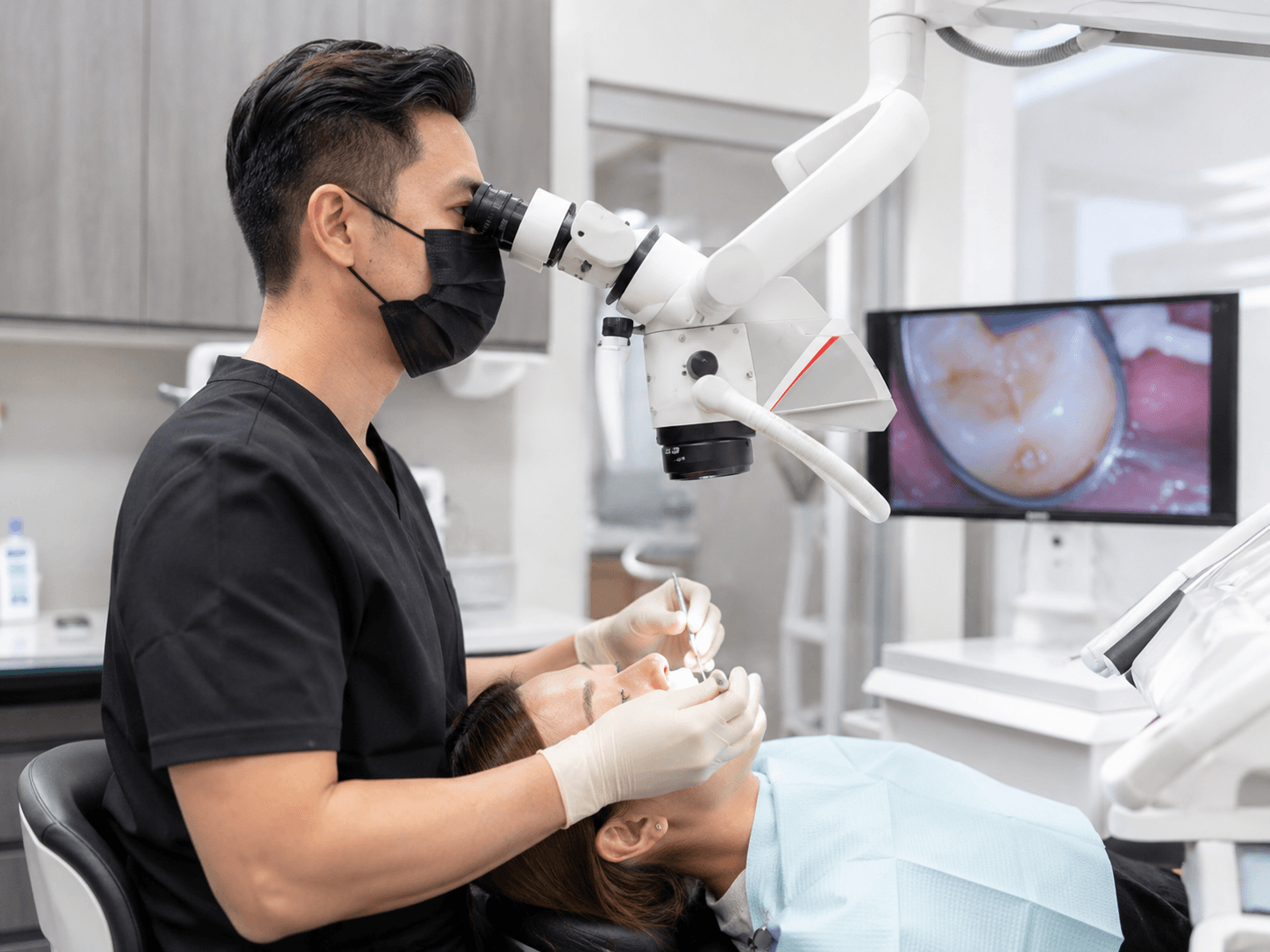
Cavities between teeth and early bone loss are invisible without proper imaging. At SoftDental, Dr. Nguyen uses the Anatomage 3D CBCT and Leica M320 microscope for cases where standard X-rays are insufficient — finding problems that would otherwise go undetected for years.
Do not ignore bleeding gums
Healthy gums do not bleed. If yours do — even occasionally — it is a clinical sign of gingivitis. At this stage, the damage is completely reversible. Tell your dentist immediately. It takes weeks to develop into periodontitis; it takes decades to regrow lost bone.
Act on sensitivity — do not dismiss it
New sensitivity to cold, heat, sweets, or pressure is your tooth's earliest pain signal — and it means decay or a crack has reached the dentin. This is not something to "wait and see" on. It is the last window before root canal territory.
Wear your night guard if you grind
Bruxism is the leading cause of cracked teeth and accelerated enamel loss — often during sleep when patients cannot monitor or control it. A custom night guard from Dr. Nguyen is the single most effective protection for patients who grind, preventing the quiet damage that leads to expensive restorations.
The best time to fix a dental problem is before it hurts.
Do not wait for pain to be your signal. Let Dr. Nguyen check what you cannot feel — and catch it while it is still simple.
Educational content only. Individual dental situations vary. Cost estimates are general ranges and may differ based on tooth location, complexity, geographic market, and insurance. All dental decisions should follow a proper clinical examination. Statistics cited from peer-reviewed clinical literature and published data through 2025. © 2026 SoftDental | Dr. Minh Nguyen DDS PA · 10028 West Road Ste. 108, Houston TX 77064 · 281-807-6111