Patients invest thousands of dollars and months of healing to get a dental implant. Then, the day the crown is placed, they leave the office feeling like the journey is over. The tooth looks real. It chews like a real tooth. It doesn't hurt. So why do anything differently than they did before? The answer lies in a biological reality that most patients never learn about — and that has nothing to do with the titanium post or the porcelain crown.
The Most Dangerous Implant Misconception
The belief that implants are "permanent" and maintenance-free is understandable and almost universally held. Titanium is one of the most durable materials in medicine. The crown on top is porcelain or zirconia ceramic — it cannot decay. Patients reasonably conclude that an implant requires no more care than brushing once in a while.
The problem is that peri-implantitis — the destructive inflammatory disease that attacks the gum and bone around an implant — is not about the titanium or the ceramic. It is about the biological tissue that surrounds the implant. And that tissue, as research now clearly shows, is more vulnerable to bacterial infection than the tissue around a natural tooth — not less.
"My implant is made of titanium and ceramic. It can't decay or get infected. I just need to brush normally — if that."
❌ What patients believe
- Implants can't get infected — they're artificial
- No cavity = no problem = no special care needed
- The bone is solid now — it won't go anywhere
- Regular brushing is all I need to do
- I only need to see a dentist if something hurts
- My implant will last forever no matter what
- Skipping cleanings doesn't affect an implant
✅ What the clinical evidence shows
- The gum and bone around an implant are living tissue — fully vulnerable
- Peri-implantitis is a bacterial disease — it doesn't care that the crown is ceramic
- Without cleaning, bone around the implant silently dissolves away
- Standard brushing misses the critical zone around the implant collar
- Peri-implantitis is often completely painless until advanced
- An implant can fail — and the tissue is harder to treat than around natural teeth
- Professional cleaning every 3–6 months reduces peri-implantitis risk by 67%
Why Your Implant Is More Vulnerable Than Your Natural Tooth
To understand why implant maintenance matters so much, you need to understand one fundamental biological difference between a titanium implant and a natural tooth. This difference is invisible on X-rays and unfelt by the patient — but it is the reason peri-implantitis progresses faster and more severely than natural tooth gum disease.
Left: A natural tooth is anchored by the periodontal ligament — a living layer of fibers perpendicular to the root, rich in blood vessels and nerve endings. These fibers insert directly into both the tooth root and the jawbone, creating a physical and biological barrier that buffers the spread of bacterial infection. Right: A dental implant achieves stability through osseointegration — direct bone contact. But without the PDL, the gum tissue around the implant collar is sealed only by parallel collagen fibers without cementum attachment points, creating a weaker barrier. Bacteria that breach this seal reach the bone faster and cause more rapid destruction than around natural teeth.
The Three Stages of Peri-Implant Disease
Peri-implant disease follows a predictable three-stage progression — from reversible gum inflammation all the way to bone destruction and implant loss. The critical window for intervention is stage one. Stage three is treated with surgery. Understanding the stages helps you understand why catching this early matters so much.
🩸 Peri-Implant Mucositis — Gum Inflammation Only
The earliest stage. Bacterial biofilm accumulates around the implant collar — exactly the same way plaque causes gingivitis around natural teeth. The gum tissue around the implant becomes inflamed, may look slightly red or puffy, and bleeds when probed by the dentist. No bone loss has occurred yet. The implant remains fully stable.
The 2025 Academy of Osseointegration/American Academy of Periodontology meta-analysis found that nearly half of all implant patients develop peri-implant mucositis — with an incidence rate of approximately 53% over 20 years. The encouraging news is that peri-implant mucositis is considered reversible once the biofilm is removed — with professional cleaning and improved home care.
Fully reversible with prompt treatment Act: More frequent cleanings + improved home care🦴 Early Peri-Implantitis — Bone Loss Begins
When peri-implant mucositis is untreated, the bacterial infection progresses below the gumline and into the bone. The peri-implant pocket deepens. X-rays begin to show early crestal bone loss around the implant. This bone loss is irreversible. The implant may still feel completely stable because substantial bone must be lost before any mobility is detectable. Many patients at this stage have no pain and no noticeable symptoms whatsoever.
The AO/AAP 2025 systematic review found that approximately one in five implant patients — about 22% — develop peri-implantitis over a 20-year period. In patients without regular supportive therapy, prevalence climbs significantly higher, reaching 26.1% in some study populations.
Bone loss is permanent — cannot regenerate without surgery Act: Surgical debridement, possible bone grafting, more frequent maintenance🚨 Advanced Peri-Implantitis — Implant at Risk of Loss
Severe bone destruction has occurred around the implant. The implant begins to show mobility — the bone integration that took months to achieve is being dissolved by the bacterial infection. At this stage, the implant may need to be removed. Even with aggressive surgical intervention, implant survival cannot always be guaranteed in advanced cases. A 40-year long-term study found that while implant survival rates were 95.6% at 38–40 years, outcomes were strongly associated with maintenance — and complications that were allowed to progress unreated required the most complex interventions.
Effective management of advanced peri-implantitis remains one of the most challenging situations in implant dentistry — significantly harder to treat than natural tooth periodontitis — because the implant surface is difficult to decontaminate and lacks the regenerative capacity that natural tooth root structure provides.
Implant removal may be requiredYour Daily Home Care Routine: Step by Step
Cleaning a dental implant requires slightly different technique and tools than cleaning natural teeth — not because the crown needs anything special, but because the implant-gum interface needs specific attention. Here is the complete daily routine, in order.
Soft-Bristled Toothbrush — Twice Daily, 2 Full Minutes
Use a soft-bristled brush — manual or electric. Place the bristles at a 45-degree angle toward the gumline where the crown meets the gum tissue. This targets the critical junction at the implant collar where plaque accumulates. Use small circular strokes — never scrubbing back and forth aggressively. Clean the front, back, and chewing surface of the implant crown and the gum tissue immediately surrounding it.
Avoid whitening toothpastes, charcoal toothpastes, or any abrasive formula. These scratch the surface of the implant crown and the abutment, creating micro-grooves where bacteria accumulate even more readily. Use a low-abrasive fluoride toothpaste or one specifically formulated for implants.
Soft bristles only · 45-degree angle · No abrasive toothpasteImplant-Specific Floss or Super Floss — Once Daily
Standard floss works for some single implant crowns, but implant-specific floss (such as Oral-B Super Floss or GUM Implant Floss) has a stiff threader end, a spongy middle section, and a standard floss tail. The spongy section is particularly effective at cleaning around the implant abutment and under the crown margin — the exact location where bacteria must be removed.
Wrap the spongy section around the implant collar in a C-shape. Gently move it back and forth and slide it up and down under the gum margin. Do not snap floss into the gum aggressively. The goal is removing the bacterial film that sits where the crown meets the tissue.
C-shape around implant collar · Spongy middle section criticalWater Flosser — Daily, at the Gumline
A water flosser (such as a Waterpik fitted with the implant-specific plastic tip, not the metal jet tip) is one of the most effective tools for implant maintenance. Set it to a low or medium pressure. Aim the tip at a 45-degree angle directly into the gumline around the implant, pausing briefly at each gap between the implant and the adjacent tooth.
The water stream flushes bacteria, food debris, and loosened plaque from the pocket around the implant where brushing and flossing alone cannot fully reach. For patients with implant-supported bridges, a water flosser is particularly critical for cleaning the area underneath the bridge.
Plastic implant tip only · Low pressure · 45° at gumlineInterdental Brush — For Spaces Around the Implant
Small interdental brushes (such as TePe or GUM Proxabrush) fit into the spaces between the implant crown and the neighboring teeth. Choose a size that fits snugly but without force — never push them in aggressively. Use plastic-coated wire brushes — never metal wire, which can scratch the implant surface and abutment.
Move the brush gently back and forth in the interproximal space, cleaning both sides. This is particularly important for patients with implant-supported bridges or multiple adjacent implants where flossing under a bridge requires a threader and the interdental brush is faster for daily maintenance.
Plastic-coated wire only · Snug fit — never forcedAlcohol-Free Antibacterial Rinse
Finish with a 30-second rinse using an alcohol-free antibacterial mouthwash. Alcohol-based mouthwashes can dry out gum tissue and, over time, irritate the peri-implant mucosa. An alcohol-free formula — or one specifically recommended by Dr. Nguyen for your situation — reduces the bacterial load in the oral environment without causing tissue dryness.
For patients with a history of periodontitis or those undergoing active peri-implant maintenance, a chlorhexidine rinse may be prescribed for short-term use. Do not use chlorhexidine long-term without specific guidance — it stains teeth and can affect taste perception with prolonged daily use.
Alcohol-free formula · 30 seconds · Ask Dr. Nguyen for your specific rinseWarning Signs: Call Dr. Nguyen Promptly
Most peri-implant disease in its early stages produces no pain and no dramatic symptoms. But there are signals to watch for — and every one of them warrants a call to the office, not a wait-and-see approach.
Gums Bleed When You Clean Around the Implant
A healthy implant site should not bleed with gentle cleaning. Bleeding on contact is the earliest and most reliable sign of peri-implant mucositis — stage one, still fully reversible.
Redness, Swelling or Puffiness of the Gum Around the Crown
Inflamed peri-implant tissue looks redder, shinier, or puffier than the surrounding gum. This inflammation is the body responding to bacterial biofilm that has not been adequately removed.
Persistent Bad Taste or Bad Breath From the Implant Area
A bad taste or odor that persists despite thorough cleaning often indicates a bacterial pocket forming around the implant — deeper than your home tools can reach. It can also signal cement residue from a cemented crown causing tissue inflammation.
Gum Recession Around the Crown — Implant Collar Becoming Visible
If you begin to see the gray or silver collar of the implant abutment above the gumline — when it was previously covered — the gum tissue has receded. This can be caused by bone loss from peri-implantitis or by biological factors that need clinical evaluation.
Any Movement or Wobbling of the Crown
A loose crown may mean the abutment screw has loosened — a fixable mechanical issue. Or it may mean the implant itself has lost bone support. Either way, a loose implant crown is an urgent issue requiring same-week evaluation.
Pain, Pressure, or Sensitivity Around the Implant
A fully integrated, healthy implant should not cause pain with normal chewing or pressure. Any new discomfort — especially if combined with any of the above symptoms — may indicate active infection or failing osseointegration.
Professional Implant Maintenance: What Happens at Every Visit
Home care alone is not sufficient for long-term implant health — and this is not a criticism of patient hygiene. Even the most diligent home cleaner cannot remove calculus (hardened tartar) once it forms on the implant surface. A 2025 review found that regular professional maintenance reduces peri-implantitis risk by 67%. Most implant patients should be seen every 3–6 months — more frequently in the first two years after crown placement, and more frequently for patients with a history of gum disease, diabetes, or smoking.
Implant Probing — Measuring Pocket Depth
The dentist uses a periodontal probe around the implant to measure pocket depth in six locations. Any increase in pocket depth compared to baseline measurements is an early sign of peri-implant disease — even before it becomes visible or symptomatic. This is the most important monitoring measurement at every maintenance visit.
Bone Level Monitoring with X-Ray
Periapical X-rays of the implant at regular intervals detect bone loss around the implant before it becomes clinically significant. The crestal bone level is compared to previous X-rays — any change triggers closer monitoring and more aggressive intervention. Dr. Nguyen uses the Anatomage 3D CBCT when a standard X-ray provides insufficient detail.
Professional Cleaning With Implant-Safe Instruments
Standard stainless steel scalers used for natural teeth can scratch and damage the implant abutment surface — creating the same bacterial-trapping grooves we are trying to prevent. Professional implant maintenance uses plastic, resin, or carbon fiber scalers specifically designed for titanium surfaces. An ultrasonic scaler with an implant-compatible tip is also used for deeper cleaning.
Abutment Screw Check and Crown Integrity
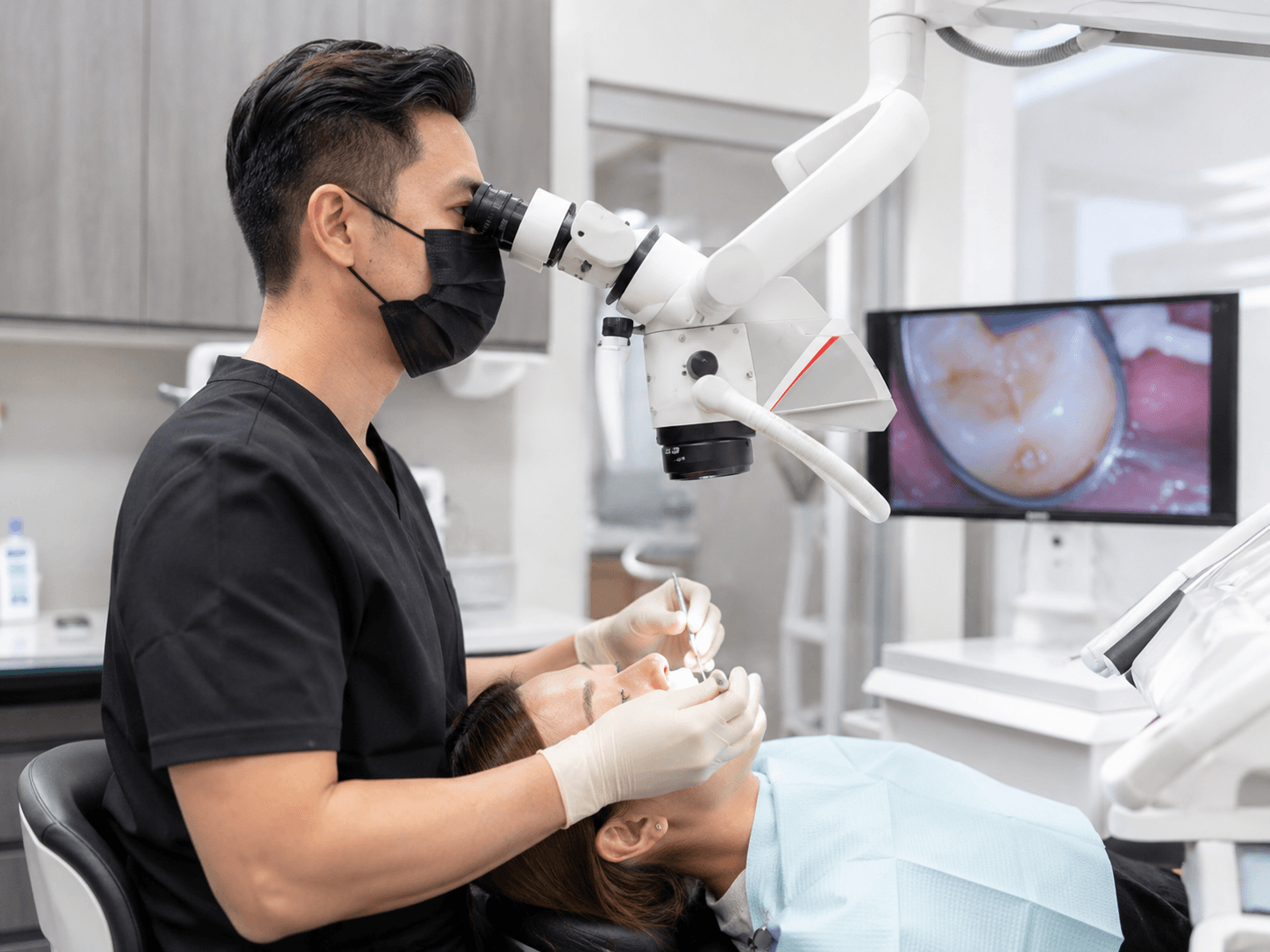
At maintenance visits, Dr. Nguyen checks the crown for any chips, fractures, or changes in the bite relationship. If the crown is screw-retained, the screw torque can be verified. If there is any mobility of the crown, the abutment connection is evaluated under magnification with the Leica M320 microscope.
Occlusal Adjustment if Needed
Over time, natural teeth wear slightly and the bite relationship changes. An implant crown does not wear the same way as natural enamel — which can create a situation where the implant is taking more bite force than intended. A simple bite adjustment at a maintenance visit prevents the chronic overloading that contributes to peri-implantitis progression.
Personalized Home Care Assessment
At each visit, Dr. Nguyen or the hygienist evaluates the effectiveness of your home care by looking at plaque indices and areas of bleeding on probing. Specific guidance is given for any areas that are being inadequately cleaned — with tool recommendations and technique instruction tailored to your anatomy.
What Actually Makes an Implant Last a Lifetime
A landmark 40-year study published in 2025 found that single-tooth implants placed in 1982–1985 had a cumulative survival rate of 95.6% over 38–40 years in function — with favorable marginal bone levels maintained over four decades. The key finding: success was strongly associated with long-term follow-up, proper case selection, and ongoing maintenance. The implants that lasted 40 years were not the ones left alone. They were the ones that were monitored, cleaned, and supported throughout their lifespan.
🪥 Consistent daily home care
Twice-daily brushing at the gumline, daily implant flossing, and water flosser use are the foundation of long-term implant survival.
📅 Professional maintenance every 3–6 months
Regular professional cleaning removes calculus the patient cannot remove, catches early signs of bone loss, and adjusts the protocol based on what X-rays show.
🛡️ Night guard if you grind
Bruxism places extreme mechanical stress on the implant crown, abutment, and bone. A custom night guard from Dr. Nguyen is the most effective protection for grinding patients.
🚭 No smoking
Smoking impairs blood flow and immune response in the peri-implant tissue — dramatically increasing peri-implantitis risk and reducing the body's capacity to resolve early infection.
🩸 Blood sugar control if diabetic
Poorly controlled diabetes impairs healing and immune function in the tissue surrounding the implant. Coordinating implant maintenance with your physician's diabetes management is part of the long-term care plan.
🔬 Leica microscope monitoring
At SoftDental, Dr. Nguyen uses the Leica M320 microscope at maintenance visits to detect early gum changes, assess the abutment seal, and monitor any peri-implant pocket development before it becomes clinically significant.
I tell every patient on the day we place their crown: this implant can last your entire lifetime. The titanium root and the ceramic crown are not going to fail on their own. But the tissue around it is alive — and bacteria don't care that your tooth is made of titanium. The implant is only as permanent as the care you give to everything that surrounds it. That is the part you control.
— Dr. Minh Nguyen, D.D.S., P.A. · SoftDental, Houston TX · Leica M320 Microscope · Bicon & Implant Direct SystemsWhen was your last implant maintenance visit?
If it has been more than six months — or if you have never had a professional implant-specific cleaning — now is the time. Early detection of peri-implant disease is easy to treat. Late-stage disease is not.
Educational content only. Individual implant situations vary significantly. Peri-implant disease prevalence statistics cited from peer-reviewed systematic reviews published through 2025 — ranges vary across studies due to differing diagnostic criteria. All clinical decisions require in-person evaluation by a qualified dental professional. The 40-year implant survival data cited from Barkarmo et al. (2025), Clinical Implant Dentistry and Related Research. © 2026 SoftDental | Dr. Minh Nguyen DDS PA · 10028 West Road Ste. 108, Houston TX 77064 · 281-807-6111